Ask for one specific thing on one specific day, and make it clear you are asking them and not floating an idea. "There's a Thai place on Mill Street I've been meaning to try. Come with me on Thursday?" That is the whole thing. Almost every ask that goes badly goes badly because one of those two halves is missing.
The rest of this is about the part nobody writes down: what to do when you are standing there with the sentence in your head and eight seconds of ordinary conversation left.
Why "we should do something sometime" never works
Because it hands them the work. They now have to guess whether you mean as friends, invent a plan, propose a day, and do all of that out loud while you watch. Most people, faced with that, say "yeah, definitely" and mean nothing by it, and then both of you carry on exactly as before.
A vague ask also protects you, which is why it is so tempting. If they never say yes, they never said no either. That trade is worse than it looks. You end up with weeks of nearly asking, which is more uncomfortable than one clear question and an answer you did not want.
So be specific. A place, or an activity, and a day. You can be wrong about both and they can counter with something else, and that is a good outcome, because it means you are now two people negotiating a plan instead of one person hinting.
Write the sentence out first
Not in your head. Actually write it, in your notes app, on the way home.
Keep it under about fifteen words and resist explaining it. Explaining is what nerves do. "I don't know if this is weird, and obviously no pressure, but I was sort of thinking, if you're free" is one sentence pretending to be an escape route, and it makes the other person's job harder, because now they have to reassure you before they can answer you.
Some versions that hold up:
"There's a thing at the Corn Exchange on Saturday. Come with me?"
"I'd like to take you for dinner. Are you free either night next week?"
"I've been wanting to ask you out for a while. Thursday, if you're free?"
That last one names what it is. If you have known them a long time and you are worried the invitation could be read as friendly, say the quiet part. It costs one clause and removes all the ambiguity.
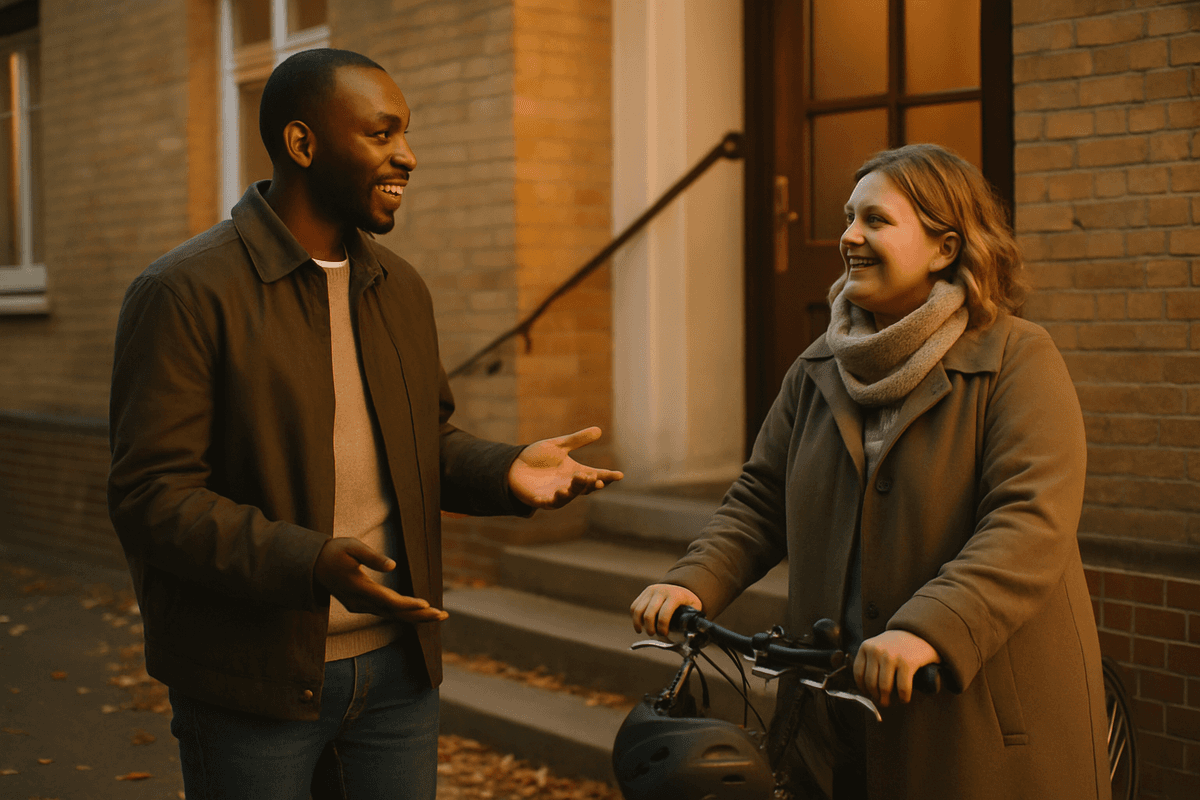
Callum, a Black man in his early thirties, stands on the steps outside their block of flats on an autumn evening asking Yasmin, a white woman around forty holding her bicycle by the handlebars, to come out with him on a specific day.
Callum, flat 3
Callum had lived across the landing from Yasmin for a year. He had taken in her parcels. She had watered his one surviving plant in July. They had a running conversation about her bike, which lived in the stairwell in defiance of a laminated notice.
First week of September, dark by eight now, and she came up the stairs with two bags of shopping. He held the door. He had a sentence ready, more or less, and he had had it ready since about the middle of August.
He said, "Bin night tomorrow."
She said, "I know, I did yours," and went inside.
Nothing bad happened. That is the problem with this. Nothing bad ever happens, so it can go on for another year. The moment on a landing with shopping in both hands is a genuinely difficult one to ask in, and Callum was not being a coward. He was being realistic about eight seconds.
Which is the argument for not doing it in the hallway at all.
Pick the moment, or make one
In person is not automatically better. In person is better when there is room: a walk, the end of something, any point where the other person is not carrying anything or halfway out of a door. If the only moments you get are eight seconds long, you are choosing between rushing it and waiting forever.
The alternative is to send it, deliberately, and let them read it alone. That is not the cowardly option. It gives them something a hallway cannot: time to think, and privacy to answer in.
Then give them room
Ask once, and stop talking. The silence after is two seconds and feels like twenty. Let it be theirs.
If they say they are busy on Thursday but sound pleased, offer one other day. "No worries. Sunday?" If they say no to that too, or the answer is a soft "maybe, I'll see how the week goes", take it as a no for now, warmly and without a follow-up. "All good. Let me know if that changes." Then genuinely drop it.
That last bit is the whole test of whether the ask was fair. An invitation someone can decline without a scene is one they can also accept without worrying about what happens if they do not.
And if you already know them well, if you are two weeks or two months into something and you want to invite them properly instead of sending "you free Friday?", all of the above still holds. The sentence is easier. The delivery is the same problem.
The sending is the hard part
A text arrives in a thread, underneath a photo of somebody's dog, and asks to be answered in words, right now, usually while they are doing something else. Your fifteen careful words get skimmed at a bus stop. That is not a reason to write worse words. It is a reason to send them somewhere they will actually be read.
An invitation that arrives as its own page does that. The plan and the day are on it, and there is a way to answer that does not require composing anything. You can build one here, on Ask4Date, from the button a few lines down, and put the sentence you already wrote into it instead of into a message thread. You will also know when it has been opened, which is otherwise the part that eats an entire evening.
Callum's sentence was fine. It had been fine for three weeks. Write yours tonight, and send it before you have time to improve it.